How to Use Singalong Prompts With Young Kids
Learn how to use singalong prompts to help young children listen, speak, remember words, and join music time with confidence and joy at home or school.
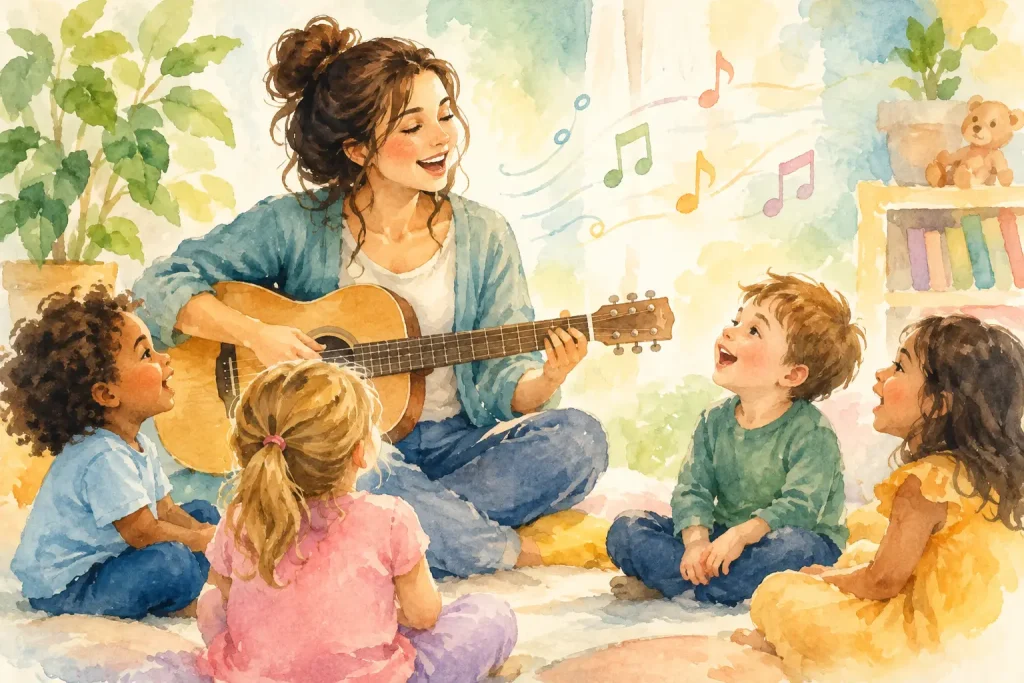
A child who knows only one word of a song can still be part of the music. That is where singalong prompts help. When you know how to use singalong prompts, you can turn a car ride, classroom circle, bedtime routine, or family music break into an active learning moment where children listen, respond, move, and feel successful.
A singalong prompt is a simple cue that invites a child to join in. It might be a question, a pause before a familiar word, a hand motion, a picture, or a repeated phrase. The goal is not to test children or make them perform. The goal is to give them a friendly opening to participate.
Start With a Song That Has a Clear Pattern
The easiest songs for prompts have repetition. Think of songs with a chorus that returns, a phrase that happens more than once, or a simple action children can copy. Repetition gives young learners a chance to hear the pattern first and join when they are ready.
Choose one short section rather than trying to prompt throughout an entire song. If the chorus says the same words each time, that is usually the best place to begin. Sing it once without stopping so children can enjoy the music. On the next round, add one small invitation.
For example, if a song includes the line, “We can clap our hands,” sing, “We can…” and pause. You can smile, hold your hands up, and let children fill in “clap” or begin clapping. A child does not have to say the word aloud for the prompt to work. Joining with a movement counts too.
How to Use Singalong Prompts Without Stopping the Fun
A prompt should feel like part of the song, not like a quiz. Keep your voice warm and your directions short. Instead of asking, “What comes next?” in a serious tone, try a playful pause, a gentle “Can you sing it with me?” or a motion that gives away the answer.
Give children enough wait time. Adults often rush to fill a quiet moment, but a three- to five-second pause can give a child time to think, remember, and respond. If no one answers, simply sing the next word yourself and keep going. There is no need to point out a missed response.
It also helps to use the same prompt more than once. The first time, children may only listen. The second time, they may do the motion. By the third or fourth time, they may sing the word with you. Familiarity builds confidence, especially for children who are shy, still learning language, or new to a group.
Match the Prompt to the Child’s Age
Toddlers often respond best to movement, sound effects, and one-word choices. Preschoolers can handle simple repeated phrases and picture cues. Early elementary-age children may enjoy taking turns leading a line, choosing an action, or listening for a rhyme.
For a toddler, you might sing, “The puppy says…” and pause for “woof.” For preschoolers, try, “If you’re happy and you know it, clap your…” and let them supply “hands.” For older children, ask them to sing an echo line after you or invent a new verse that fits the song’s pattern.
Every child develops at a different pace, so adjust the challenge as needed. A prompt that is too easy can feel boring, while one that is too hard can make a child pull away. Look for the sweet spot where they can succeed with a little support.
Use Different Types of Prompts
Changing the kind of prompt keeps music time lively and supports more than one learning style. You do not need elaborate materials. Your voice, face, hands, and a few simple pictures can do a lot.
- Pause prompts: Stop before a familiar word or phrase and let children finish it.
- Echo prompts: Sing or say a short line, then invite children to repeat it.
- Action prompts: Ask children to clap, stomp, wave, march, or point when they hear a certain word.
- Choice prompts: Offer two silly or sensible options, such as “Do we hop or tiptoe?”
- Picture prompts: Hold up a drawing, coloring page, or object that matches the next word in the song.
You can also use call-and-response. Say, “When I say ‘A,’ you say…” and let children answer “apple,” “awesome,” or another word that fits your song. This works especially well when music supports letter learning, vocabulary, or positive character messages.
Let Body Language Do Some of the Teaching
Children are often ready to participate before they are ready to sing clearly. A gesture can make a prompt easier to understand and less intimidating. Point to your ears for “listen,” place a hand over your heart for “kind,” or make a big marching motion when the song calls for movement.
Facial expression matters too. Look excited when the chorus is coming. Lean in during a pause. Celebrate participation with a smile, a thumbs-up, or a simple “You got it!” These small signals help children understand that music time is a safe place to try.
For children who communicate differently or are still building speech skills, gestures, picture choices, and movements can be especially meaningful. Participation should never depend on speaking at the same level as everyone else.
Build Prompts Into Everyday Routines
Singalong prompts do not need a special event. They work well when they support a routine children already know. A cleanup song can include a pause before “put it away.” A hand-washing song can prompt children to name “soap,” “water,” or “scrub.” A morning song can invite each child to wave when they hear their name.
At home, use prompts during transitions that are sometimes difficult, such as getting dressed, leaving the park, or settling down for bed. A short familiar song can make the next step feel more predictable. In a classroom, use the same opening or closing prompt each day so children know what to expect.
If you use music from Alphabetical Man, choose one repeated lyric or letter-based phrase and pair it with a motion. Keep the routine simple enough that children can lead it after a few listens.
Make Room for Child-Led Ideas
Once children know a song, let them help shape the prompts. Ask them to choose the next action, suggest a rhyming word, or decide when the group should clap. This gives them ownership without requiring a big performance.
A child may suggest something silly, and that is often a good thing. If the group sings about marching like superheroes, invite them to show what their superhero march looks like. Laughter can make repetition more memorable, as long as everyone feels included.
In a mixed-age group, give older children a leadership job while younger children copy along. An older child can hold a picture card, choose an action, or sing the first half of a call-and-response line. This keeps everyone involved at an appropriate level.
Avoid Turning Prompts Into Pressure
Singalong prompts work best when children have the freedom to watch first. Avoid putting one child on the spot with a question they may not want to answer. Group prompts are usually gentler: “Can we all make the rain sound?” or “Who can show me a quiet clap?”
If a child gives a different answer than expected, build on it when you can. Maybe the song asks for an animal sound and the child barks instead of meows. You can say, “Great barking! Let’s hear the cat next.” That response protects confidence while guiding the group back to the song.
Keep sessions short when attention is limited. Two cheerful minutes of music can be more effective than ten minutes of repeated directions. End while children are still engaged, especially with younger learners.
The best singalong prompt is often the smallest one: a pause, a clap, a word, or a wave that says, “There is a place for you in this song.” When children feel that invitation, they are more likely to listen closely, try new words, and carry the joy of music into the rest of their day.

Written by the Alphabetical Man team
We make songs, stories and a coloring book starring the superhero whose suit is made of letters. Our posts share simple, practical ideas for helping little ones love letters, music and kindness.
Meet Alphabetical Man