Teaching Basic Rhythm Through Playful Music
Teaching basic rhythm helps young children listen, move, count, and create. Try simple, playful activities at home, in class, or during music time today.
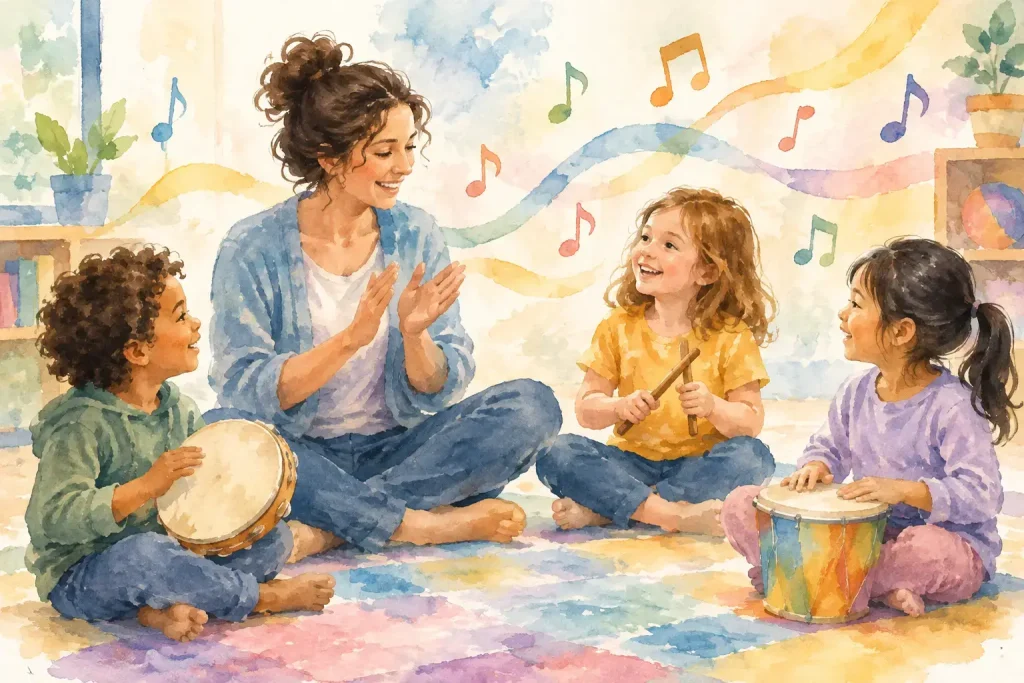
A child who can clap along to a favorite song is doing more than keeping busy. They are listening closely, noticing patterns, using both sides of their body, and learning that sounds can work together. Teaching basic rhythm gives young learners a joyful starting point for music, movement, early counting, and confident self-expression.
The best part is that rhythm does not need a special room, expensive instruments, or a music degree. It can begin with hands, feet, a table, a song, and a grown-up willing to join the beat. For toddlers and elementary-age children, the goal is not perfect timing. The goal is to help them hear a steady beat and feel successful making music.
Start With the Steady Beat
Before children learn fast patterns or music symbols, they need to recognize a steady beat. Think of it as the dependable pulse underneath a song, like a calm heartbeat that keeps going even when the words change.
Choose a song with a clear, medium-speed beat. A song that is too fast can make children feel rushed, while one that is very slow can be harder for active little ones to follow. Play the music and clap once for each beat. Keep your motion simple and repeat it for a short time.
Then invite the child to copy you. Say, “Can you find the beat with me?” instead of asking them to “do it right.” That small change matters. It makes rhythm feel like a shared game rather than a test.
If clapping is tricky, try tapping knees, patting the floor, marching, or gently bouncing a stuffed animal. Some children connect with rhythm through their whole body before their hands are ready to keep time. That is completely normal.
Let Children Feel the Beat First
Young children often learn rhythm through movement before they can explain it. Marching is especially helpful because each step creates a clear, even pulse. Put on a familiar song and march around the room together. Encourage children to stop when the music stops and begin again when it returns.
This activity builds listening skills as well as body control. It also gives energetic children a positive way to participate. If a child starts moving ahead of the music, simply slow your own steps and let them watch. Gentle modeling works better than repeated correction.
Teaching Basic Rhythm With Everyday Sounds
Once a child can join a steady beat for a few moments, introduce simple sound patterns. A pattern is a set of sounds that repeats. Start with two easy choices: a loud clap and a quiet tap, or a clap and a knee pat.
Make a short pattern such as clap, clap, pat. Repeat it three or four times, then pause. Ask the child to echo what they heard. Keep the first patterns short enough for success. A child who proudly copies three sounds is building a foundation that can grow over time.
Call-and-response works beautifully here. You make a rhythm, and the child answers with the same rhythm. Later, let them become the leader. When children create a pattern for an adult to copy, they learn that their ideas matter. They are not only following music. They are making it.
Kitchen tools can add excitement without turning the activity into a noisy free-for-all. A wooden spoon and a plastic container can become a drum. Two blocks can become rhythm sticks. Dry beans in a tightly sealed container can make a shaker, with close adult supervision. Set one simple rule before starting: instruments play when the leader gives the signal.
That rule helps children practice waiting, watching, and taking turns. It also makes the quiet moments part of the fun. Try holding up a hand for “freeze” and lowering it for “play.”
Use Words Children Already Know
Words make rhythm easier to understand because children can hear how language has its own patterns. Names are a wonderful place to begin. Slowly say a child’s name while clapping the parts you hear. For example, “Ma-ri-a” can have three claps, while “James” may have one strong clap.
You can use favorite foods, animals, or actions too. “Ap-ple” gets two claps. “Ba-na-na” gets three. “Jump” gets one. Say the word, clap it, and let the child repeat it. Soon, invite them to choose the next word.
This is a playful connection between music and early literacy. Children begin to notice that words can be broken into smaller sound parts. There is no need for a long lesson or technical vocabulary. A few minutes during snack time, cleanup, or a car ride can be enough.
Try a Rhythm Story
Turn a familiar story into a listening game. Pick a repeated word or action, then assign it a sound. Each time the word appears, children clap, tap, or shake an instrument.
For example, if a story includes a dog, children can pat their knees every time they hear “dog.” If it includes rain, they can rub their hands together to make a soft rain sound. This keeps children involved while they practice attention and timing.
For a superhero-style twist, invite children to create a “helping beat” for a character who is solving a problem, sharing supplies, or cheering up a friend. Alphabetical Man can be a fun reminder that learning, kindness, and creativity all belong in the same adventure.
Keep Rhythm Time Short and Repeatable
A great rhythm activity does not have to last 30 minutes. For many preschoolers, five focused minutes is more useful than a longer activity that ends in frustration. Young children learn through repetition, so it is fine to play the same clapping game again tomorrow.
Watch for signs that a child needs a change. If they begin banging wildly, wandering away, or getting silly in a way that stops listening, switch from instruments to marching or a freeze game. If they are deeply focused and want another turn, add one small challenge, such as a faster pattern or a new sound.
It depends on the child, the setting, and the time of day. A group of excited kindergarteners may need big movements and clear stop signals. A quiet child at home may prefer tapping softly beside a trusted adult. There is no single correct way to experience rhythm.
Celebrate Effort, Not Perfect Timing
Children will often speed up, slow down, skip a beat, or invent a completely different pattern. Those moments are part of learning. Instead of saying, “No, that’s wrong,” try, “I heard your strong claps. Let’s listen for the beat together one more time.”
Praise specific effort. You might say, “You waited for the stop signal,” “You copied that pattern carefully,” or “You made your own rhythm.” Specific encouragement helps children understand what they are doing well and gives them a reason to keep trying.
Avoid adding too many concepts at once. A child does not need to learn note names, music notation, counting systems, and instrument technique in the same session. First, help them hear and make a beat. The rest can come later.
Bring Rhythm Into Ordinary Moments
Rhythm belongs outside formal music time. Clap while putting toys away: one clap for each toy in the bin. March from the bedroom to the bathroom. Tap a beat while waiting for lunch. Make a quiet pattern while standing in line.
These small moments show children that music is not something reserved for a stage. It is something they can carry with them. Rhythm can help a child settle, move, listen, laugh, and connect with the people around them.
The next time a child starts tapping on the table or stomping across the room, pause before asking them to stop. Listen for the pattern. You may have just found the beginning of a music lesson, a movement break, and a happy shared memory all at once.

Written by the Alphabetical Man team
We make songs, stories and a coloring book starring the superhero whose suit is made of letters. Our posts share simple, practical ideas for helping little ones love letters, music and kindness.
Meet Alphabetical Man