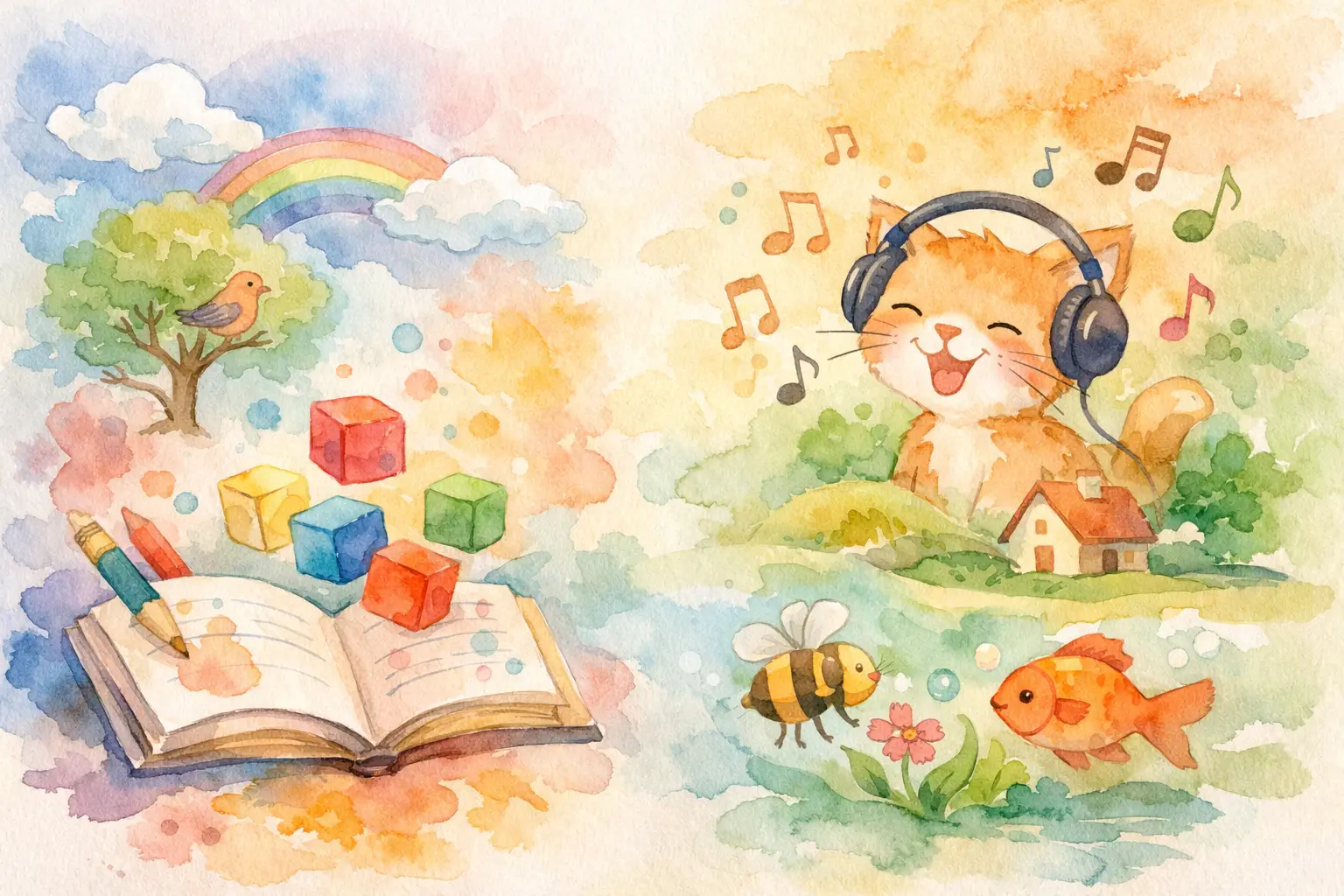
One song gets kids cheerfully singing A, B, C all the way to Z. Another helps them hear that B says /b/ and M says /m/. When parents compare alphabet songs versus phonics songs, the real question is not which one wins. It is which one helps with the skill your child is working on right now.
That distinction matters because these songs teach different things. They may both sound playful, simple, and kid-friendly, but they support different parts of early literacy. If a child can sing the alphabet but struggles to connect letters to sounds, that is not a failure. It just means the music has taught one foundation and not the next one yet.
For parents, caregivers, and early educators, that can be a relief. You do not need to choose one camp forever. You just need to know what each type of song is designed to do and when it makes sense to use it.
Alphabet songs versus phonics songs: what is the difference?
Alphabet songs usually teach letter order and letter names. They help children become familiar with the alphabet as a sequence. That is useful because kids do need to recognize letters, remember their names, and understand that print has a stable system.
Phonics songs focus on letter sounds or sound patterns. Instead of teaching that the letter is called B, they teach that B often makes the /b/ sound. Some phonics songs stay at the single-letter level, while others move into blends, vowel sounds, digraphs, or word families.
A simple way to think about it is this: alphabet songs help children know the letters, while phonics songs help children use the letters to read and spell. Both matter, but they are not interchangeable.
This is where grown-ups sometimes get mixed signals. A child who sings the alphabet with confidence can seem more advanced than a child who cannot. But if that same child cannot identify the first sound in bat or match the sound /s/ to the letter S, reading may still feel hard. Singing is not the same as decoding.
What alphabet songs do well
Alphabet songs are popular for a reason. They are catchy, predictable, and easy for young children to memorize. That repetition can build confidence early. A toddler or preschooler who can join in feels successful, and that positive feeling counts.
These songs are especially helpful for introducing the idea that letters have names and that the alphabet follows a specific order. That matters when children start using alphabet books, classroom charts, and simple dictionaries later on. Letter order also supports tasks like finding a section on a bookshelf or understanding where a letter falls in the sequence.
Alphabet songs can also create a gentle on-ramp to literacy routines. For very young children, just hearing letter names often and seeing them paired with visuals can increase familiarity. A song can turn what might feel abstract into something joyful and memorable.
Still, there is a limit. Knowing the alphabet song does not automatically mean a child can identify letters out of order. Some children can sing the whole song but pause when shown a single letter card. Others know the melody so well that LMNOP sounds like one long letter. That is common, and it is one reason alphabet songs should be seen as a starting point, not the whole reading plan.
What phonics songs do well
Phonics songs are more directly connected to early reading. They teach children to notice the sounds inside words and connect those sounds to print. That skill is a big step toward sounding out simple words.
A strong phonics song slows things down enough for kids to hear sounds clearly. It might repeat a target sound, pair it with example words, and give children chances to say it back. That helps build phonemic awareness and letter-sound knowledge together.
For example, a child who hears a song about the /m/ sound in moon, mouse, and map is practicing more than memory. That child is learning to listen for a sound pattern and link it to the letter M. That is much closer to what happens during reading.
Phonics songs can also help children who need a more active, multisensory way to learn. Music, motion, repetition, and visual cues often work well together, especially for early learners who are not ready for long seated lessons. A song can make practice feel lighter while still being purposeful.
The trade-off is that phonics songs may feel less instantly familiar to adults. Most parents grew up with a classic alphabet song. Phonics songs can sound more instructional, and some are better than others. If a song is too fast, too busy, or not very clear about the target sound, it may entertain without teaching much.
When to use alphabet songs and when to use phonics songs
This is where context matters more than labels. If your child is very young and just beginning to notice letters, alphabet songs are a good fit. They build familiarity and comfort. They can also support routines like pointing to letters in a book, on a puzzle, or on a wall chart.
If your child already knows many letter names, phonics songs often become more useful. Once a child can recognize letters, the next helpful step is learning what those letters do in words. That is where phonics has more power.
For preschool and kindergarten, many children benefit from both. One song can build recognition of letter names, and another can strengthen sound awareness. You do not have to pick a side. You can match the song to the moment.
If a child is frustrated with beginning reading, it often helps to shift toward phonics songs more often. Not because alphabet songs are bad, but because reading depends heavily on sound-letter connections. A child who knows names but not sounds may need a bridge.
If a child is overwhelmed by formal instruction, alphabet songs can still have a place. They offer easy wins. The key is not to stop there.
How to tell if a song is actually helping
The best test is not whether your child enjoys the song, though enjoyment certainly helps. The better question is what your child can do after hearing it several times.
After alphabet songs, can your child point to named letters? Can they recognize letters outside the song context? Can they find the first letter in their name?
After phonics songs, can your child produce the target sound? Can they match the sound to the letter? Can they notice the sound at the beginning of a simple word?
Those little follow-up moments matter. If a song stays inside the speaker and never shows up in real life, it may be more entertainment than learning tool. That is not useless, but it is different.
A good song should make the next step easier. It should carry over into conversation, book time, play, coloring, or simple word practice. That transfer is where growth starts to show.
Making music part of a real literacy routine
Songs work best when they are part of a bigger rhythm, not the entire lesson. A short music moment can introduce or reinforce a concept, then a quick hands-on activity can help children apply it.
After an alphabet song, you might look for letters on cereal boxes, in bath toys, or on a coloring page. After a phonics song, you might play a game where your child finds objects that start with the target sound. Keep it simple. Young kids learn well through short, repeated experiences.
This is also where character-driven learning can shine. Children often connect more deeply when a trusted, upbeat character makes learning feel friendly and fun. A positive musical experience can help kids stay open to repetition, which is something early literacy needs plenty of.
If you use music at home or in a classroom, consistency matters more than perfection. A few minutes a day of clear, cheerful practice usually beats an occasional long lesson. Kids remember what comes back again and again.
The best answer is usually both
In the debate around alphabet songs versus phonics songs, the strongest answer for most children is both, used with purpose. Alphabet songs build familiarity with letter names and order. Phonics songs help children connect those letters to the sounds needed for reading.
The mistake is assuming they do the same job. They do not. If you know what each one is good at, it becomes easier to choose music that supports your child instead of just filling the room with catchy background noise.
For families who want learning to feel positive, musical, and child-friendly, that is good news. You do not need complicated materials to help early literacy grow. You just need the right kind of song at the right time, a little repetition, and a lot of encouragement.
A child singing with confidence today may be sounding out simple words before you know it, especially when the music is doing more than entertaining.