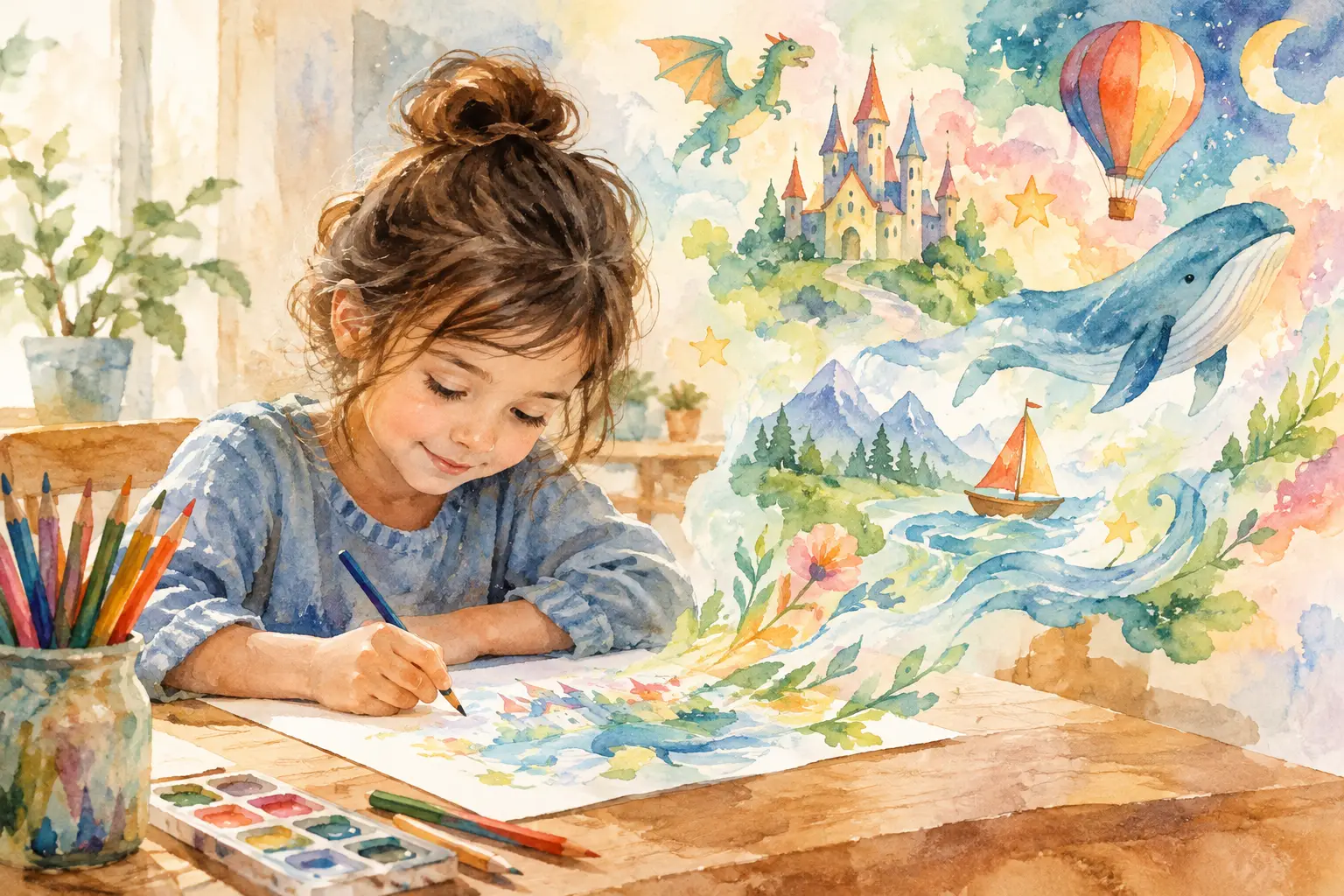
A child draws a purple dog with rocket boots, then covers the page with rainbows because the dog needs a sky to fly through. That is more than a cute picture. It is storytelling, problem-solving, and self-expression happening with a crayon in hand. Knowing how to encourage imaginative drawing means giving children room to follow those surprising ideas instead of steering every picture toward a neat, recognizable result.
For young children, drawing is not mainly about making something that looks realistic. It is a way to show what they notice, remember, wonder about, and invent. A scribble can be a storm. A circle can be a magic doorway. When adults respond with curiosity, children learn that their ideas are worth sharing.
How to Encourage Imaginative Drawing Without Taking Over
The biggest gift an adult can give a young artist is permission to make choices. It can be tempting to say, “Draw a house,” then demonstrate the square, roof, and windows. That kind of practice has its place, especially when a child asks for help. But imaginative drawing grows when the child remains the director of the page.
Try beginning with an open invitation rather than a set of instructions. You might say, “What could live under the sea if it did not have to be a fish?” or “What kind of vehicle would take a teddy bear to the moon?” These questions offer a starting point without deciding the answer.
If a child pauses and says, “I don’t know what to draw,” avoid rushing in with a solution. Ask what they like right now: animals, trucks, superheroes, bugs, music, space, or silly food. Then add one playful twist. A dinosaur who loves cupcakes, a bus that travels underwater, or a letter of the alphabet with a secret power can get an idea moving.
Use prompts that leave room for surprises
The best prompts are specific enough to spark interest and open enough to welcome many answers. Keep them light. There is no correct way to draw a dream, a sound, or a made-up creature.
Here are a few prompts to keep near the art table:
- Draw a new friend for your favorite stuffed animal.
- Invent a place where every tree grows something unexpected.
- Create a superhero whose power helps people in your neighborhood.
- Draw what a happy song would look like if it had colors and shapes.
- Design a tiny home for an ant, a fairy, or a friendly robot.
Prompts work best as invitations, not assignments. If the child starts by drawing something completely different, that is a win. Their imagination has taken the lead.
Make Art Supplies Easy to Reach
Children are more likely to draw when they do not need to wait for a special activity or an adult to set everything up. A small, reachable art space sends a simple message: your ideas can happen here.
You do not need a large craft room or expensive supplies. Plain paper, recycled paper, crayons, washable markers, colored pencils, tape, and child-safe scissors can go a long way. Add a few unexpected materials now and then, such as cardboard tubes, tissue paper, stickers, or paper shapes. Different tools invite different kinds of ideas.
A big sheet of paper may inspire a map, a giant creature, or a family of characters. A small notepad can feel like a secret sketchbook. It depends on the child. Some children love a full table of choices, while others feel calmer with just a few crayons and one page.
Try not to correct color choices. A green sun or an orange cat is not a mistake. It may be part of a story the child has not explained yet. Realistic drawing skills can come later. First, children need to feel free enough to experiment.
Ask About the Story, Not the Accuracy
Adults often say, “What is that?” when they see a child’s drawing. Although the question is well meant, it can make a child feel as if the picture needs to be recognizable to count. A more encouraging response focuses on the child’s ideas and effort.
Notice details you genuinely see. Say, “I see lots of fast lines around this character. It looks like something exciting is happening,” or, “You used so many colors in this part. Tell me about it.” Then listen. The answer may be simple, funny, or wonderfully detailed.
You can also ask questions that help the story grow: “Where is this character going?” “What happens next?” “How does this machine work?” “Who could help if there is a problem?” These questions build language skills along with creativity, but they should never feel like a quiz.
If a child does not want to talk, let the drawing speak for itself. Some children draw quietly because the process is relaxing. A warm comment such as, “I like seeing you work on your idea,” is enough.
Praise choices and persistence
General praise like “Good job!” is kind, but children gain more from hearing what they did. Try, “You kept adding details until your city had roads, parks, and a fire station,” or, “You found a new way to make those wings.” Specific encouragement helps children see themselves as capable creators.
It also helps to normalize changes. If a marker line goes somewhere unexpected, say, “That line could become part of the picture. What might it turn into?” A so-called mistake can become a tail, a river, a laser beam, or the beginning of a whole new scene.
Add Music, Movement, and Make-Believe
Imagination does not always begin at the table. Sometimes a child needs to move, hear a story, or act out an idea before they are ready to draw it. Play an upbeat children’s song and ask what pictures the music brings to mind. March like a brave hero, flap like a giant bird, or pretend to explore a jungle, then invite the child to draw one moment from the adventure.
This approach is especially helpful for children who say they do not like drawing. They may enjoy storytelling, singing, or building more than sitting still. Drawing can become one part of the play instead of a separate task. A child who creates a cape from a towel may later want to draw the hero who wears it.
Alphabetical Man’s playful superhero spirit can offer a fun starting point too: invite children to imagine a letter hero with a helpful mission. What does the hero wear? Who do they help? What special tool do they carry? The goal is not to make every drawing look the same. It is to show that letters, characters, and stories can become original ideas.
Create a Gentle Routine for Drawing
A regular drawing time makes creativity feel familiar rather than high-pressure. Ten or fifteen minutes after school, before dinner, or during a quiet weekend morning can be enough. Leave the routine flexible. Some days a child may fill three pages. Other days they may only make a few marks or choose to watch.
Avoid turning every drawing into a project to finish, display, or share. Children need private, unfinished, and even messy creative time. Keep some drawings in a folder or binder so they can look back and notice how their ideas change over time.
Displaying a few pieces can still be meaningful. Let the child choose what goes on the refrigerator, wall, or family bulletin board. Ask whether they want to add a title or tell you a caption. Giving them control over sharing builds pride without putting them on stage.
Help When Frustration Shows Up
“I can’t draw” usually means, “My picture does not look the way I hoped.” Meet that feeling with patience. You might say, “Drawing can feel tricky when you have a big idea in your head. Want to try one small part first?” Break the idea into simple choices: the character’s face, one special object, or the place where the story happens.
Offer help only after asking. “Would you like me to show you one way to draw a wheel, or would you rather make up your own?” This keeps the child in charge. If they want a model, draw beside them rather than on their paper. Your version can be one possibility, not the standard they must match.
For some children, copying is a comfortable first step. Let them copy a simple shape, a favorite character, or a family object, then encourage one change of their own. Maybe the character gets different shoes, a new pet, or a home in the clouds. Copying can lead to invention when it is treated as practice, not the final destination.
Let Their Pictures Be Theirs
Imaginative drawing flourishes in a home or classroom where children know they will not be judged, rushed, or corrected at every turn. Keep supplies close, offer a playful question, and pay attention to the story behind the marks. Small moments of encouragement can help a child see that their ideas have value.
The next time a page fills with zigzags, strange creatures, or a sun in an unexpected color, pause before asking what it is supposed to be. Instead, make space for the child to show you where their imagination decided to go.