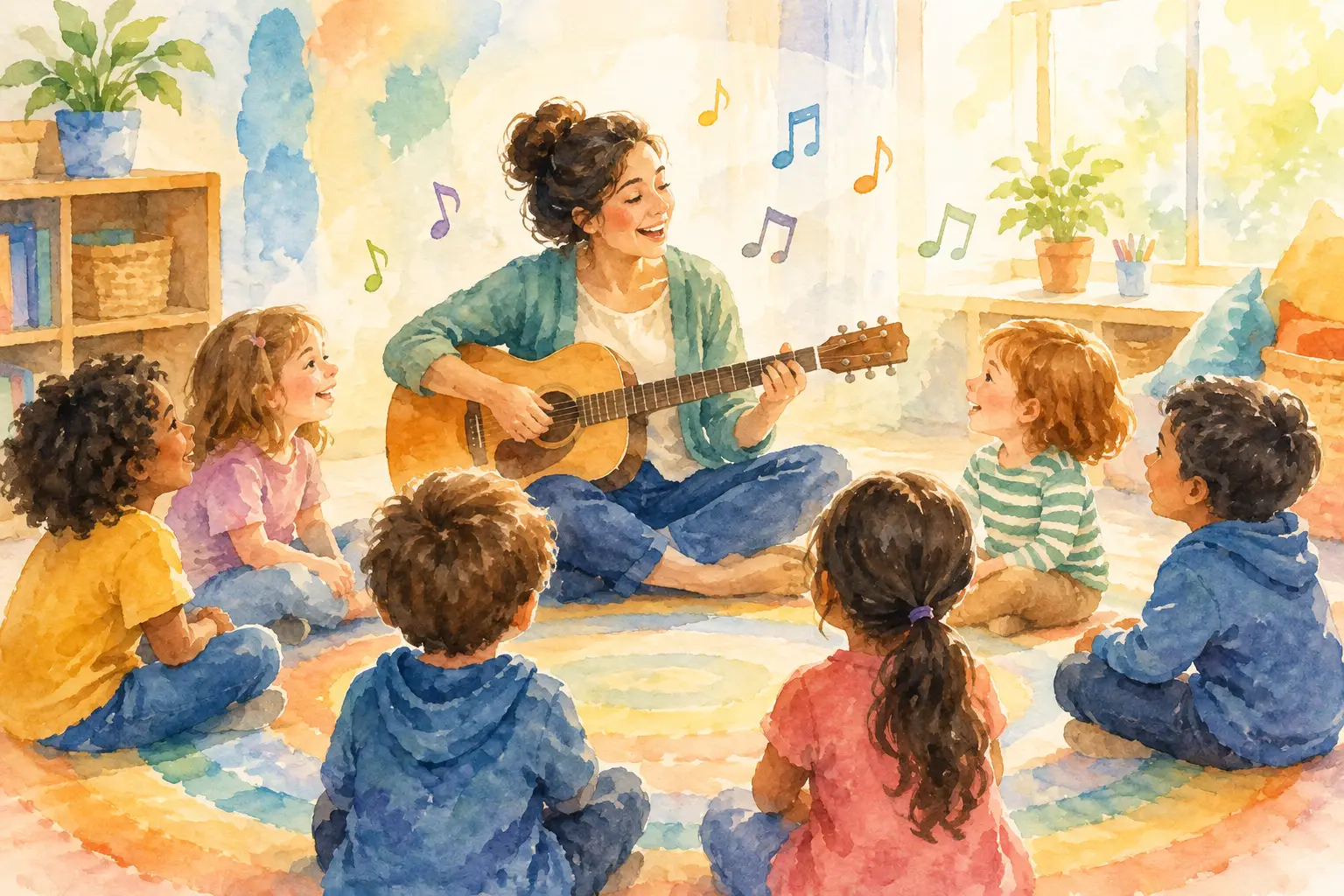
A morning circle can set the feeling for the next several hours. When children enter with different energy levels, worries, or excitement, music gives everyone a friendly place to begin together. These examples of songs for morning circle are simple, active, and easy to adjust for preschoolers and early elementary students.
The best choice is not always the loudest or fastest song. A strong morning-circle song gives children a clear job: greet someone, listen for a name, move their body, notice the day, or share a feeling. That little bit of structure can help a classroom feel safe, cheerful, and ready to learn.
12 Examples of Songs for Morning Circle
1. A Good Morning Greeting Song
Start with a short call-and-response song that welcomes the group: the adult sings a greeting, and children sing it back. Add each child’s name when time allows. Hearing their name in a warm, predictable routine helps children feel seen before the day’s work begins.
For a large class, greet groups instead of every child. You might welcome the children wearing sneakers, the children who rode the bus, or the children sitting in a certain area. This keeps the song moving while still making it personal.
2. The Name-and-Clap Song
Invite each child to say their name and clap its syllables. The group repeats the name and clap pattern together. It is a playful way to build name recognition, listening skills, and early awareness that words have parts.
Keep the rhythm steady and let children choose a simple motion if clapping is not comfortable. A tap on knees, a wave, or a quiet drumbeat works just as well.
3. Hello in Many Ways
A hello song can become a daily lesson in kindness. Sing a simple greeting, then change how children greet one another: wave hello, smile hello, sign hello, nod hello, or give themselves a gentle hug.
This is especially helpful when children have different comfort levels with touch. No child should have to hug, high-five, or make eye contact to participate. Offering choices makes the circle more welcoming for everyone.
4. The Feelings Check-In Song
Use a calm melody to name feelings such as happy, tired, excited, nervous, frustrated, or peaceful. Children can point to a picture card, show a number with their fingers, or hold a hand over their heart instead of speaking aloud.
A feelings song does not need to turn into a long conversation every morning. Its job is to give children words for what they carry into the room. If a child needs more support, follow up quietly after circle time.
5. Days of the Week Song
The days-of-the-week song is a classic because repetition makes it stick. Sing the days in order, then ask one quick question: What day was yesterday? What day comes next? For older early learners, add a calendar helper who points to the current day.
Use the same melody for several weeks before changing it. Children gain confidence when they can anticipate what comes next and join without being prompted.
6. Today’s Weather Song
Look out the window and sing about what the class notices: sunshine, clouds, wind, rain, snow, or a changing sky. Let a child be the weather reporter and choose the matching picture or symbol.
This song works best when it is observation-based. If the forecast says sunny but the window shows gray clouds, trust what children can see. That small habit encourages curiosity and careful noticing.
7. The Alphabet Action Song
Choose a letter each day and pair it with an easy action or sound. Children can march for M, bounce for B, or pretend to fly for F. Keep the focus on hearing and recognizing the letter rather than getting every sound perfect.
Alphabetical Man can be a fun character cue for a letter-themed morning when children need an extra reason to join in. A superhero-style mission, such as finding objects that begin with the letter of the day, turns a familiar routine into active learning.
8. The Color of the Day Song
Sing about one color and invite children to spot it around the room. Red might appear in a book cover, a block, or a friend’s shirt. Then ask children to name another object that could be that color.
Color songs work well for toddlers and preschoolers because they connect music to the objects children already know. They can also lead naturally into coloring, sorting, or a quick classroom scavenger hunt later in the day.
9. Count and Move
Pair counting with simple movements: five stomps, three reaches, eight taps, or ten slow marching steps. Change the number to meet your group’s skills. Younger children may count to five, while kindergarten students may count forward, backward, or by twos.
The goal is not to make children move faster. A steady beat helps them coordinate listening, counting, and movement without feeling rushed.
10. The Helping Hands Song
Create a short song about classroom jobs and caring for shared spaces. Mention putting away supplies, holding doors, watering a plant, or helping a friend find a seat. Children can sing the job they have that day or volunteer a helpful idea.
This kind of song supports character education without sounding like a lecture. When kindness becomes part of the daily rhythm, children begin to see helping as something the whole group does.
11. The Quiet Listening Song
Not every morning circle needs more energy. A gentle song with a repeated cue such as listening ears, calm hands, or slow breaths can help the room settle before a story or lesson.
Use a quiet listening song after a high-energy arrival, indoor recess, or a transition from breakfast. Some children need movement first, while others need calm first. Watch the group and choose what the moment calls for.
12. The Goodbye-to-Home, Hello-to-School Song
For children who struggle with separation, a reassuring transition song can be powerful. The message can be simple: grown-ups come back, friends are here now, and there are good things to do at school.
Avoid forcing children to sing if they are upset. Let them hold a comfort item, sit near a trusted adult, or simply listen. Participation can grow over time when children feel safe.
How to Choose Songs for Morning Circle
A useful morning circle usually has one greeting, one learning focus, and one moment for movement or calm. That may take five minutes for toddlers or fifteen minutes for an elementary group. Longer is not always better. If children begin wiggling, talking over one another, or losing the beat, shorten the routine instead of adding more songs.
Think about what your class needs that day. A rainy Monday may call for a lively action song. A group returning from a busy assembly may benefit from a breathing song and a soft hello. Familiar songs create comfort, but adding one new song every week or two keeps the routine fresh.
It also helps to keep songs easy enough for children to lead. A child who can point to the weather card, choose a motion, hold a rhythm instrument, or start the first line is practicing confidence along with music skills.
Make the Routine Work for Every Child
Offer more than one way to participate. Children can sing, hum, move, point, hold a picture card, use a communication device, or listen nearby. This matters for children who are still learning English, who are sensitive to sound, or who simply need time before joining a group.
Keep the words clear and repeat key phrases. Visual supports such as name cards, calendar pieces, feeling faces, and color cards make songs easier to follow. If your classroom uses instruments, introduce them with a purpose. A shaker for the beat or a drum for each name can add excitement, but too many sounds at once can make circle time harder to manage.
Most of all, let the music serve the children, not the schedule. A simple welcome song sung with warmth can do more for a child’s morning than a perfectly planned routine. When children know they belong, they are ready to learn, create, and share their own good energy with the room.