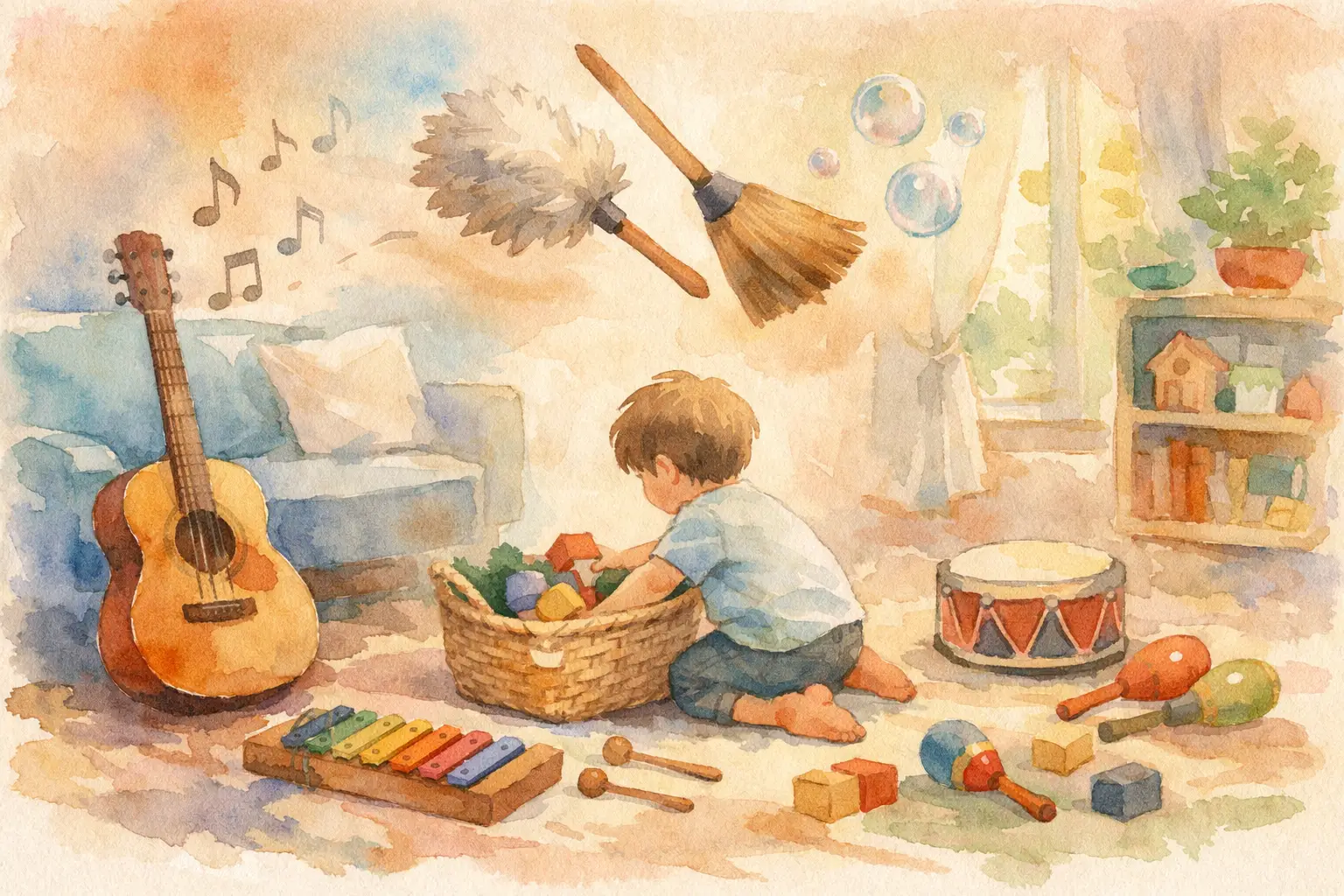
The blocks are everywhere, the crayons have rolled under the table, and the next part of the day is waiting. For a young child, being told to “clean up” can feel huge. When you build musical cleanup routines, that big job becomes a familiar little mission with a beat, a beginning, and a finish line.
Music gives children a cue they can hear, remember, and enjoy. It also turns cleanup from a power struggle into a shared activity. A simple song will not make every toy disappear on the first try, but it can help children practice responsibility, listening, sorting, and teamwork one small task at a time.
Why music helps cleanup time work
Young children respond well to repetition. They learn that a certain tune means it is time to gather toys, put books back on the shelf, or carry cups to the kitchen. After hearing the same song again and again, they need fewer reminders from an adult.
A musical cue is often gentler than calling instructions across the room. Instead of saying, “Stop playing right now,” you can start the cleanup song and join in. The message stays clear, but the mood feels more encouraging.
Songs also create a natural sense of time. Children can hear when the song is starting, when it is almost over, and when it is time to check the room. This matters because “clean your room” is hard to measure for an early learner. “Put the cars in the bin before the chorus ends” is much easier to understand.
Build musical cleanup routines around one clear job
Start small. A cleanup routine works best when children know exactly what belongs where. Choose one area, such as the playroom, art table, classroom reading corner, or bedroom floor. Then give each type of item a clear home.
For toddlers, the goal may be as simple as putting stuffed animals into one basket. Preschoolers can sort blocks, dolls, and pretend-food pieces into separate containers. Elementary-age children can handle larger jobs, such as returning books to a shelf, folding a blanket, or clearing a homework space.
Avoid beginning with a full-house cleanup song. That can feel overwhelming for children and tiring for adults. A short routine that succeeds each day is more helpful than a big plan that only happens once.
Pick a song with a predictable shape
Your cleanup song does not need fancy words or a perfect melody. It needs to be easy to repeat. A familiar tune can work, or you can make up a simple chant with a steady clap.
Try a pattern like this: begin with a line that names the task, repeat a line that tells children where items go, and end with a cheerful signal that says the job is done. Keep the song short enough to sing two or three times. If it goes on too long, children may lose focus.
You might sing, “Toys in the basket, books on the shelf. We help our room and we help ourselves.” The words can change for the space you are cleaning. For art time, mention crayons and paper. For mealtime, mention plates and napkins.
The best lyrics are concrete. “Put things away” is fine, but “Blue blocks in the blue bin” gives a child a useful next step.
Add movement, not pressure
A beat invites movement. Clap while walking to the toy bin, tap knees before picking up books, or march gently from the table to the sink. These small actions help children stay connected to the task.
Keep the mood playful, not frantic. Racing against a song may excite some children, especially older kids, but it can frustrate others. A child who needs extra time or has trouble with transitions may do better with a slower song and one item category at a time.
It depends on the child and the moment. If your child is already tired, hungry, or upset, lower the energy. Sing quietly, clean alongside them, and focus on one easy win. The routine is meant to build confidence, not create another reason to feel rushed.
Make the routine easy to see
Music is strongest when it works with the room instead of fighting it. Clear bins, picture labels, low shelves, and a small hamper make cleanup more possible for children. They cannot put items away independently if the right place is hard to reach or hard to identify.
For children who are not reading yet, add a simple picture to each container. A photo or drawing of blocks on the block bin makes sorting more straightforward. Older children can help make labels, which gives them ownership of the system.
Choose only a few categories at first. Too many tiny bins can turn cleanup into a matching game with confusing rules. Three broad homes are often enough: one for building toys, one for pretend play, and one for soft toys. You can add more detail as your child grows.
Use the same cue at the same moments
A cleanup song becomes powerful through consistency. Use it after free play, before dinner, at the end of a classroom center, or before leaving the park. The exact schedule will depend on your family or learning space, but the cue should be reliable.
If you use music for every single request, it can lose its special meaning. Save the song for routines that happen regularly. A different short tune for morning clothes, bath toys, or bedtime books can be helpful, but start with one cleanup routine before adding more.
Adults can support the habit by joining the first few minutes. Children learn more from seeing cleanup modeled than from hearing repeated commands. Pick up an item, sing the next line, and notice effort out loud: “You found the puzzle box. That is where it belongs.”
Praise should be specific and sincere. Rather than saying only “Good job,” name what happened. “You put every marker in the cup,” or “We worked together until the floor was clear,” helps children understand the success they created.
Give children a role in the song
Children are more likely to participate when the routine feels like theirs. Let them choose a clap pattern, suggest a rhyme, or be the person who starts the music. A child who loves superheroes might announce that it is time for a room-rescue mission. A child who loves animals might use a silly animal sound at the end of each verse.
This is also a good chance to practice early literacy. Point to a few repeated words in the lyrics, such as “toys,” “books,” “clean,” or “help.” Let children hear rhyming pairs like “floor” and “door.” The goal is not a formal lesson. It is simply showing that words, sounds, and daily life belong together.
A positive character like Alphabetical Man can add extra fun when children need a friendly reminder that helpful habits are something to celebrate.
Adjust when the routine stops working
Even a favorite song can wear out. If children start ignoring it, change one part without replacing the whole routine. Add a new verse, switch the clapping pattern, or invite a child to sing the last line. Small changes keep the experience fresh while the cleanup expectation stays the same.
If the routine regularly falls apart, look for the real obstacle. Maybe there are too many toys out at once. Maybe the bins are too full. Maybe cleanup is happening after a long day when everyone has reached their limit. Reducing the number of available toys, using larger containers, or starting five minutes earlier can make a bigger difference than a new song.
Some days will still be messy. That is normal. The purpose is not a picture-perfect room. It is helping children learn that shared spaces deserve care and that they can contribute in meaningful ways.
When the last toy is put away, pause for a moment. Look at the clear floor, sing the final line together, and let your child feel the pride of helping create a calm place to play again.